The screen below is a Virora calendar filled with sample data. The first week of September is solid red, the end of the month is dashed, and in between there's a green band with a dashed ring inside it. Each one means something different.
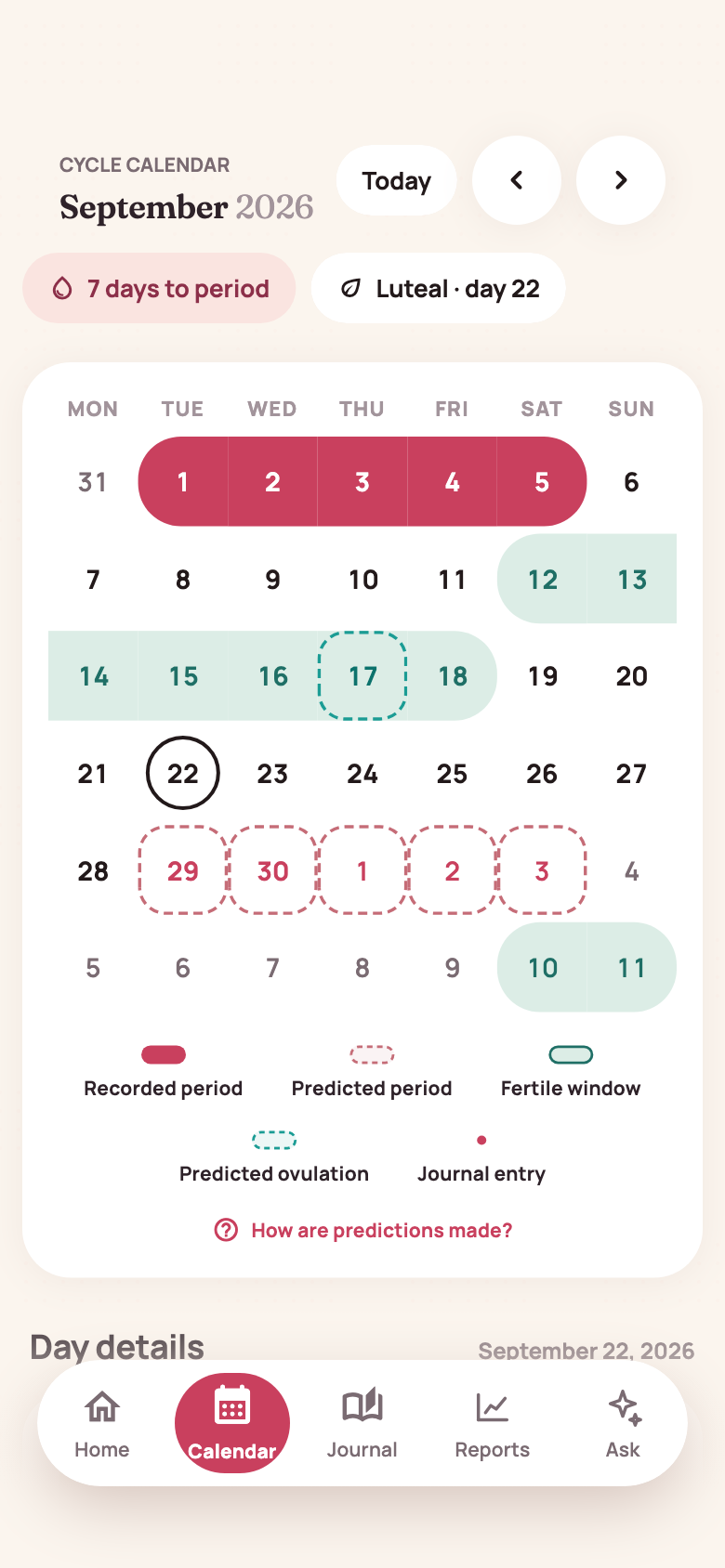
A September 2026 calendar with sample data.
Solid red (1–5 September) is what you logged: your period started and ended on these days. Dashed red (29 September–3 October) is the prediction for your next period. The green band (12–18 September) is the predicted fertile window, and the dashed green ring inside it (17 September) is the predicted ovulation day. If a day has both a record and a prediction, the calendar shows the record.
Where do the dashed days come from?
Virora measures the number of days between each period start you log. Your next start is your latest logged start plus the cycle length worked out from those gaps. Three things shape the calculation.
Your last three cycles count more than older ones, so when your rhythm shifts, the prediction catches up within a few months. Once you have at least four cycles logged, a single cycle that is clearly longer or shorter than the rest is left out — a month when you were ill or travelling won't skew the whole year. With no records yet, the average cycle and period length you entered at setup are used, or 28 and 5 days if you didn't know them.
How many dashed days you see comes from the average of your recent periods that have an end date. If you've never logged an end, the setup value is used.
A made-up example: your last starts were 2 August, 31 August and 27 September. The gaps are 29 and 27 days, so the prediction points 28 days ahead, to 25 October. If your period starts on 23 October and you log it, the calendar rebuilds the next prediction from 23 October.
The calendar shows predictions roughly a year ahead. Next month's is far more reliable than the one six months out.
The green band and predicted ovulation
The predicted ovulation day is found by counting back from your next predicted period start — 12 days by default. The phase after ovulation varies less between people than the phase before it, so counting back gives steadier results than counting forward. NHS: Fertility in the menstrual cycle The green band runs from five days before that day to one day after. In the example above, the next period is expected on 29 September; counting back 12 days puts ovulation on 17 September and the fertile window on 12–18 September.
Virora doesn't measure hormones; the green band is a calendar estimate. It can't be used for contraception.
When your period is late
When the days since your last start reach the predicted cycle length and you haven't logged a new one, the home screen shows a "Your period is late" card with the number of days. The predicted start moves forward to today each day, so the calendar doesn't pin you to a date that has already passed. If period reminders are on, you'll get a nudge on day 2 and day 5 of the delay.
When your period starts, tap "My period started" on the home screen. It logs today as the first day, and predictions are recalculated from the new date straight away.
Habits that make predictions more accurate
Log the start on the day it happens; if it started on another day, pick that day in the calendar. Mark the end with "My period ended" too — that's the only way the dashed days start to match your own period length. To fix a wrong date, tap the record in the calendar and use "Edit period record" to change or delete it; predictions update immediately. Don't fill in old dates from guesswork: a made-up entry shifts every calculation after it.
The Regularity card
After three logged cycles, a Regularity card appears on the home screen. It labels your cycles "Regular" or "Variable" and shows your shortest and longest cycle side by side. The label is "Regular" when all your cycles are 21–35 days long and differ by no more than 7 days. If you see "Variable", read the dashed days as a range of a few days rather than a single date.
A few days' variation is normal for most people. If your cycle changes noticeably, your period is late several times in a row, or you might be pregnant, talk to a healthcare professional. NHS: Irregular periods